TonicNest may earn a commission if you buy through links on this page, at no extra cost to you. That does not change what we report.
Part of our Sonovive overview. Last checked October 19, 2026.
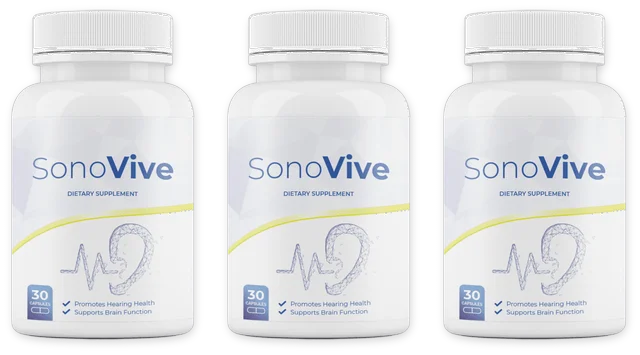
Does Sonovive work for hearing or tinnitus: no published trial has tested the product, and none of its eight label ingredients has controlled human evidence for either use. The vendor's own label lists a memory-style stack led by 250 mg of St. John's Wort[1].
Outside bodies agree on the wider point. The AAO-HNS tinnitus guideline recommends against dietary supplements for persistent tinnitus[4], and the NIDCD says no supplement advertised for tinnitus "has been proven to be effective"[5].
Does Sonovive work? The short answer
Sonovive has not been shown to improve hearing or quiet tinnitus. We found no trial of the finished capsule, and the vendor names none. Its references page links 28 items, mostly news and blog articles, and none is a study of Sonovive[1].
The label is transparent, which helps. Every dose is printed, so each ingredient can be compared with the research. That comparison is where the hearing case falls apart: ginkgo and vinpocetine, the two ingredients with any hearing data, appear at a fraction of the studied dose, and the data itself is weak.
What we cannot say is that Sonovive will do nothing for any one person. Tinnitus loudness shifts from week to week, which is why controlled trials matter. Without one, an improvement a buyer notices cannot be credited to the capsule.
Which evidence levels should you not confuse?
Four levels of evidence get blended together in supplement marketing, and Sonovive has reached only the first two. A product claim is strong only when it reaches level three or four.
1. Plausibility
A mechanism story is the lowest level. The FAQ says Sonovive "strengthens the link between hair cells and brain cells"[3]. That describes how something might work and tests nothing.
2. Ingredient trials
Studies of single ingredients come next. A 2022 Cochrane analysis rated ginkgo's tinnitus benefit over placebo as uncertain, with low to very low certainty evidence[6]. A 12-week trial of 46 people found St. John's Wort plus ginkgo "did not improve the symptoms of subjective tinnitus"[7]. These results describe the ingredient at its trial dose, not Sonovive.
3. Finished-product trial
A randomized, placebo-controlled study of the actual capsule would show whether the product works. None exists in anything we read. The FAQ line that "tests have indicated" results in 9 to 12 weeks names no test[3].
4. Replication
Confidence comes when a second team repeats a positive result. Sonovive has no first result to repeat.
Sonovive claims vs what the evidence supports
The sales page and FAQ make hearing claims that the label and the research do not back. The table sets each claim beside a fair reading of it.
| Vendor claim | Reasonable reading | Limitation |
|---|---|---|
| "Promotes Hearing Health" (label) | A general support claim, not a measured result | No label ingredient has human hearing evidence at these doses |
| Supports hearing "in a new and revolutionary way" (sales page)[2] | Marketing wording | No trial of Sonovive named or found |
| Addresses "the root cause of hearing loss" (FAQ) | A mechanism story | No study tests it, in people or otherwise |
| Results in "9-12 weeks" (FAQ) | A suggested trial period | No test named; the refund window is 60 days |
| A "dropper" of "plant extracts" (sales page) | Describes a different format | The label shows a 30-capsule bottle with amino acids and phosphatidylserine |
Read the label as the authority. Some copycat pages online list a different ingredient set under the same name, so compare the bottle you receive with the vendor label we read on October 19, 2026[1].
Which ingredients matter most?
Three label items have any hearing or tinnitus research: ginkgo, vinpocetine and St. John's Wort. All three are mismatched with that research on dose or result.
- Ginkgo, 50 mg. Tinnitus studies use 120 to 240 mg a day, so the label gives a half to a fifth of that. The evidence at full dose is still uncertain[6].
- Vinpocetine, 2 mg. The one hearing study gave 30 mg a day for 12 months with no control group, so the label has 1/15 of that dose[8].
- St. John's Wort, 250 mg. The biggest dose on the label. Its only tinnitus trial was negative[7].
The other five are memory ingredients. Bacopa at 120 mg is 40% of the 300 mg used in memory trials, which found small gains in attention and recall[10]. N-Acetyl L-Carnitine did not change age-related hearing loss in rats[9], and huperzine A's hearing data comes from rodents only[11], at 10 mcg on the label against 400 to 800 mcg studied for memory.
The study groups differ too. Most trials enrolled people with depression, dementia or memory complaints, not people with hearing loss. Our Sonovive ingredients breakdown covers each one.
What results are realistic to expect?
Going by what the trials measured, the realistic expectation is no measurable change in hearing. The outcomes studied were hearing thresholds and tinnitus scores, and the controlled studies did not favor these ingredients.
The timeframes were 12 weeks for the St. John's Wort tinnitus trial[7] and 12 months for the uncontrolled vinpocetine study, where hearing got worse over the first 6 months before improving[8].
The vendor suggests about 3 months of use, yet the refund window is 60 days. If you try it, judge it before day 60 so the refund stays open. Our guide on how to take Sonovive includes a simple log.
When should you see a doctor instead?
Ringing in the ears is a symptom with many causes, and some need medical care. Before buying any supplement, see your doctor or an audiologist and get a baseline hearing test.
See a doctor right away if:
- you lose hearing suddenly, in one or both ears
- tinnitus is in one ear only, or pulses in time with your heartbeat
- the ringing comes with dizziness, vertigo or loss of balance
- it starts after a head injury
- you have ear pain, discharge or weakness in your face
- the noise is causing anxiety, low mood or poor sleep that does not lift
Evidence conclusion
On current evidence, Sonovive is an untested product whose ingredients do not support a hearing claim at the doses printed.
| Decision question | Current assessment |
|---|---|
| Has Sonovive been tested in people? | No trial found or named, checked October 19, 2026 |
| Do the ingredients help hearing at label doses? | No controlled human evidence for any of the eight |
| Do guidelines back supplements for tinnitus? | No. AAO-HNS recommends against them[4] |
| Is the label transparent? | Yes, every dose is printed[1] |
| Is there a refund route? | 60 days, through the vendor or ClickBank |
If you still want to try it, check the label against your medicines first using our Sonovive side effects guide.
Back to the Sonovive overview.
Frequently asked questions
Does Sonovive really work for tinnitus?
No study shows it does. No trial of Sonovive exists in what we read, St. John's Wort plus ginkgo did not improve tinnitus in a 12-week trial, and the AAO-HNS guideline recommends against supplements for persistent tinnitus.
How long does Sonovive take to work?
The vendor FAQ says supplements take 9 to 12 weeks, but it names no test behind that figure. The refund window is 60 days, so anyone trying it should decide before then to keep the refund option, checked October 19, 2026.
Is there a clinical trial on Sonovive?
We found none. The vendor references page links 28 items, mostly news and blog articles, and none is a study of the Sonovive capsule. Ingredient studies used other doses and mostly enrolled people with memory or mood problems.
Can Sonovive bring back lost hearing?
No evidence supports that. The FAQ says the formula strengthens links between hair cells and brain cells, but no human study of any label ingredient shows hearing returning at these doses. See an audiologist about hearing loss.
Sources
- References and product label. SonoVive, read October 19, 2026.
- SonoVive Text Presentation (sales page). SonoVive, read October 19, 2026.
- Contact Us and FAQ. SonoVive, read October 19, 2026.
- Clinical practice guideline: tinnitus (AAO-HNS, 2014), PMID 25273878. PubMed, National Library of Medicine, read October 19, 2026.
- Tinnitus. National Institute on Deafness and Other Communication Disorders (NIDCD), read October 19, 2026.
- Ginkgo biloba for tinnitus, Cochrane analysis 2022, PMID 36383762. PubMed, National Library of Medicine, read October 19, 2026.
- St. John's wort with ginkgo vs ginkgo alone in subjective tinnitus, randomized trial, PMID 37176699. PubMed, National Library of Medicine, read October 19, 2026.
- Vinpocetine in sensorineural hearing loss, phase II open-label study, PMID 33712282. PubMed, National Library of Medicine, read October 19, 2026.
- Acetyl-L-carnitine and age-related hearing loss in rats, PMID 18620587. PubMed, National Library of Medicine, read October 19, 2026.
- Bacopa monnieri and cognition, meta-analysis of 9 randomized trials, PMID 24252493. PubMed, National Library of Medicine, read October 19, 2026.
- Huperzine A and hearing, rodent study, PMID 31554431. PubMed, National Library of Medicine, read October 19, 2026.
This page is general information, not medical advice. Dietary supplements are not reviewed by the FDA for safety or effectiveness before they are sold and are not intended to diagnose, treat, cure or prevent any disease. Talk to your doctor before taking any supplement, especially if you are pregnant, nursing, take medication or have a health condition.